GO SHOOT THE "VIEJA"
IPOs with our money to keep the game going

“Go shoot that old woman”! These are the words that emerged from the investigations in the aftermath of a banking scam that I have personally witnessed during my career in commercial banking in Italy.
There was this branch whose director was always praised for his stellar performance compared to all of the other colleagues. The message during the director’s meetings was, “You all should try to do like him. Why aren’t you as good as him?”
It turned out, from the investigation, that he had created a scheme of circular financing where fake companies were created and given a credit line. The companies would just bill one another in a closed and controlled circle of bogus payments. When payments came due, new credit lines were issued, and money was syphoned off and diverted to a criminal organization of which he was part.
The only missing ingredient for the perfect crime was the money needed to pay the interest maturing on the circular debts.
The solution? Take it out of the account of an old man that never checked because he had full trust in the bank director.
Eventually, the old man, being well over 95 years of age, died just when the bubble was already very well inflated, and the family, his old wife, the vieja, and children, came to the bank to claim the money of the deceased.
That's when they found out that the money was missing and they reported it to the police.
The order came through a phone call from the bank Director to the Mob. Like a Mafia threat: “GO SHOOT THE VIEJA” (Andate a sparare alla vecchia.) The transcript of that conversation was obtained by the authorities.
What do we learn from this real story? That a circular financial system can only last until real cash can be extracted from real sources, to keep it from collapsing.
Hence the words from BLACKROCK: “take it from the pension funds”!
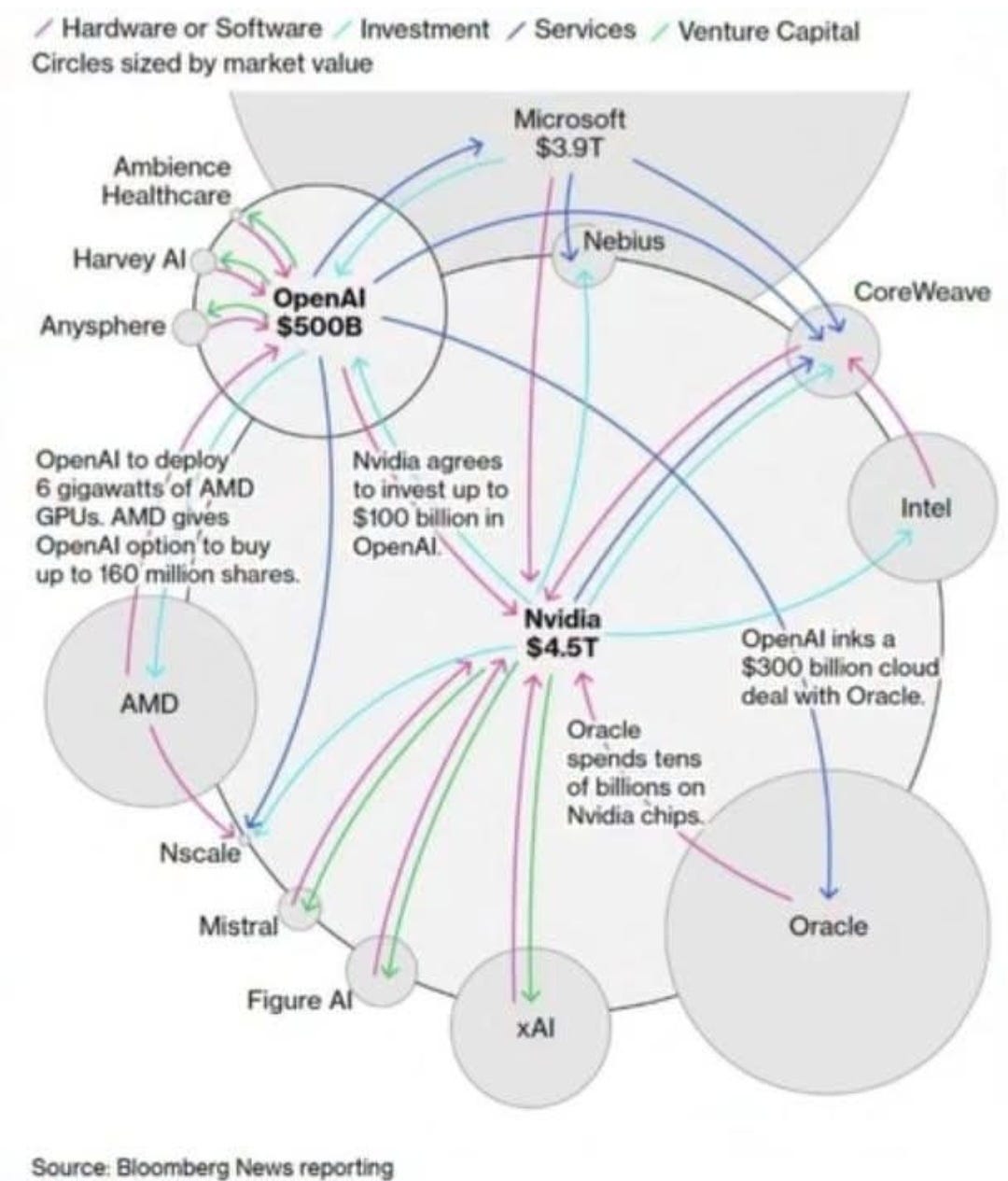
Is it much different from this?
Here is what is reported by the excellent Andrei Jikh:
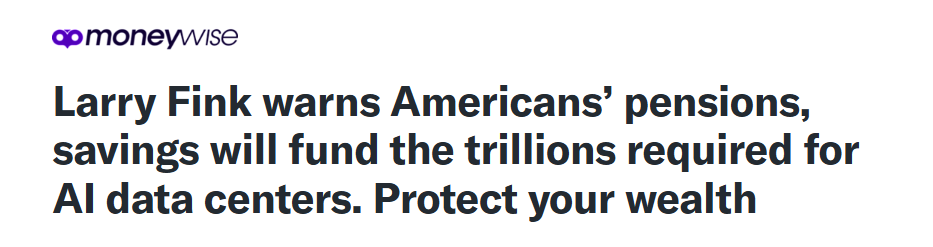
We’re living in a time that might be remembered as one of the biggest bubbles in history. And that’s because in the next few weeks, your retirement account and your 401k are going to be buying shares in some of the biggest IPOs in human history, even though you might not want to. Okay, how’s that going to happen? It’s going to happen because the rules of the financial system were just rewritten to make sure that your money is going to be buying it automatically. Now, this is actually more than just a theory. Larry Fink from BlackRock, which is the biggest asset management company in the world, said that your retirement funds and pension funds will be used to build out this AI infrastructure. And so much of this money is going to be coming from the private sector, from savings accounts, from pension accounts, from insurance companies, and on and on and on.
So, let me explain how this is going to happen. In the finance world, there’s a concept called the IPO, or the initial public offering. That’s when a private company goes public. It’s when investors all around the world are finally able to buy shares and invest in a company. And one of those companies that’s going public soon is SpaceX. And the value of that company is going to be $1.75 trillion. Now, to put that number in perspective, it would make SpaceX on day one more valuable than every American defense contractor combined. It would also be the biggest IPO in human history, even bigger than Saudi Aramco, which held that record since 2019. The difference, though, is that Saudi Aramco was the most profitable company on the planet when it listed. But SpaceX lost $5 billion last year. Now, the craziest part about all of this, though, is that the financial rules that are supposed to protect us from buying these overpriced investments at the wrong time were also just changed right before these IPOs. That’s because on May 1st, the NASDAQ introduced something called the “fast entry rule”, which cuts the waiting period for a company to be included in an index from 3 months to just 15 trading days. And what it also does is it gets rid of something called the float requirement that would have disqualified SpaceX, for example, from being included. The rule change will also force index funds to artificially inflate how much of the company they’ll have to buy.
So, what we now have is a handful of insiders that got in really early at low prices, and now they need to exit. And to exit, they need buyers. They need a lot of buyers. Buyers that are going to absorb trillions of dollars worth of stock at peak values so that the insiders can walk away.
But finding enough of these buyers for the biggest IPOs in history is going to be really hard unless you change the rules. Which means now your 401k might be the exit liquidity they need. Now the story gets even crazier because SpaceX is just the first company in line, but right behind it is OpenAI and Anthropic. They’re doing their own IPOs and going public. So, we’ll have three companies with a combined valuation of about $4 trillion. So, SpaceX, OpenAI, and Anthropic would leapfrog every other company in America, basically on day one. And that’s why some people are saying that this is going to be a bubble the likes of which we have never seen before, and we’re all going to fund it with our own retirement money.
(To fund this AI infrastructure, these companies need money. They obtain cash by borrowing it, and after, they bill one another, in a circle… not much different from the small-scale scam that I described)
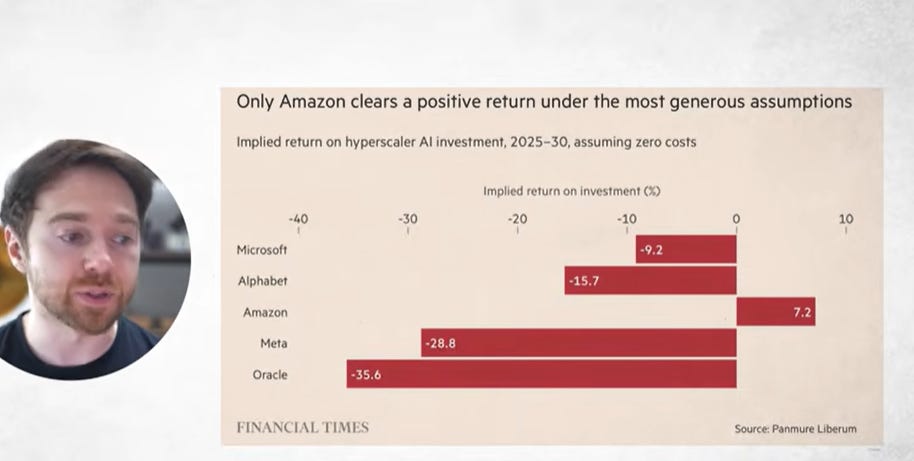
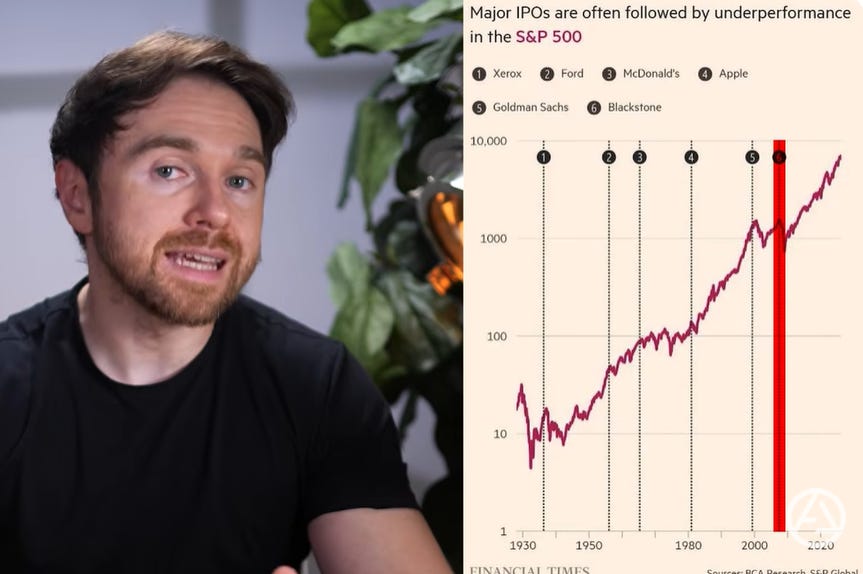
When the earnings that justified the stock prices get revised downward, the whole loop goes in reverse. So this theory says that is why the timing of all of this is so important to them. That’s why they changed the rules. That is why there’s such an urgency to get these IPOs to go public as fast as possible. They need these IPOs to validate the paper before the paper runs out. There’s a chart from the Financial Times that I think is really interesting. It shows the biggest, most hyped, most culturally significant IPOs in American history against the S&P 500, aka the stock market. It shows companies like Xerox went public when investors were desperate to own it and then the market peaked right after. Ford went public when investors were desperate to own it. The market peaked right after. McDonald’s, Apple, Goldman Sachs, Blackstone, every single one of these companies went public at the same moment when public excitement about owning them was at the highest point. And in almost every single case, the market peaked right after.
That’s because the IPO is rarely about the company needing money, right? It’s almost always about the seller needing a buyer. And the best time to find a buyer is when everyone wants what you’re selling
So, what do we learn? When time runs out, funds are needed instantly.
If cash isn’t readily available anymore, it’s time to GO SHOOT THE VIEJA. That means they’ll get it from the pension funds.
In Europe, the same thing:

The message is clear. They desperately need our money and our savings, and they will legally take it.
The Vieja is getting shot, and she is all of us.
Thanks so much for writing this article! I can’t turn 59.5 years old fast enough! I really enjoyed your book! It was Awesome